


Suzhou Chengyuda Textile Co., Ltd. is one of the most reliable manufacturers and suppliers of ifr velour in China, also supports customized service. We warmly welcome you to wholesale high-end ifr velour made in China here from our factory. If you have any enquiry about quotation and free sample, please feel free to email us.
Fabric Introduction
IFR velour is a heavy cut-pile fabric whose flame retardancy is a property of the fibre rather than a finish added afterwards. The pile is dense and short, cut evenly across the cloth, so the surface reads as a soft matte field that absorbs light instead of glinting - which is why it holds a deep colour under stage lighting, and why it is chosen where a drape has to look solid rather than shiny. It hangs with real weight and falls into full, quiet folds.
Why inherent flame retardancy
IFR stands for inherently flame retardant, and the name describes where the performance comes from: the polymer itself. The flame-retardant component is built into the fibre before it is spun into yarn, so it is present through the full thickness of every filament rather than resting on the surface of the cloth.
That is the difference from FRT - flame retardant treatment - which is applied to a fabric after it has been woven. A treated cloth depends on the finish staying where it was put, and washing, abrasion, professional cleaning and long service all work against it. An IFR velour cannot lose its flame performance in the same way, because there is no separate finish to wear off. Batch consistency is also easier to hold, and the hand of the cloth stays soft instead of being stiffened by chemistry.
Both routes exist in the market, and both appear in our fabric range: some qualities are marked FR Treatment on the sample card, others are inherently flame retardant. IFR is the route to specify where a drape will be cleaned repeatedly, where the venue asks for a documented material, or where the fabric will stay in service for years.
Available scenes
Stage
On stage the curtain is both scenery and machinery. The main drape closes the proscenium so the audience reads a clean opening, while masking legs and borders hide the wings and the flies; the fabric also absorbs reflected sound, which is why a deep velvet drop is chosen for a hall that would otherwise sound brittle.

Sports hall
A sports hall turns the curtain into a wall. One very tall run lines the end or the long side so balls stop hitting bare blockwork, the playing surface is protected from stray light and draughts, and the space reads as a proper arena for spectators. Because it covers a large uninterrupted span, the fabric has to take abrasion and hold its colour.

Exhibition hall
At a trade fair the curtain is the stand's back wall, and it has one job: to give the display a clean, closed background instead of the hall behind it. It is built on a portable frame, erected by the stand contractor, and taken down again at the end of the show, so the fabric and the headings have to survive repeated handling.
Conference room
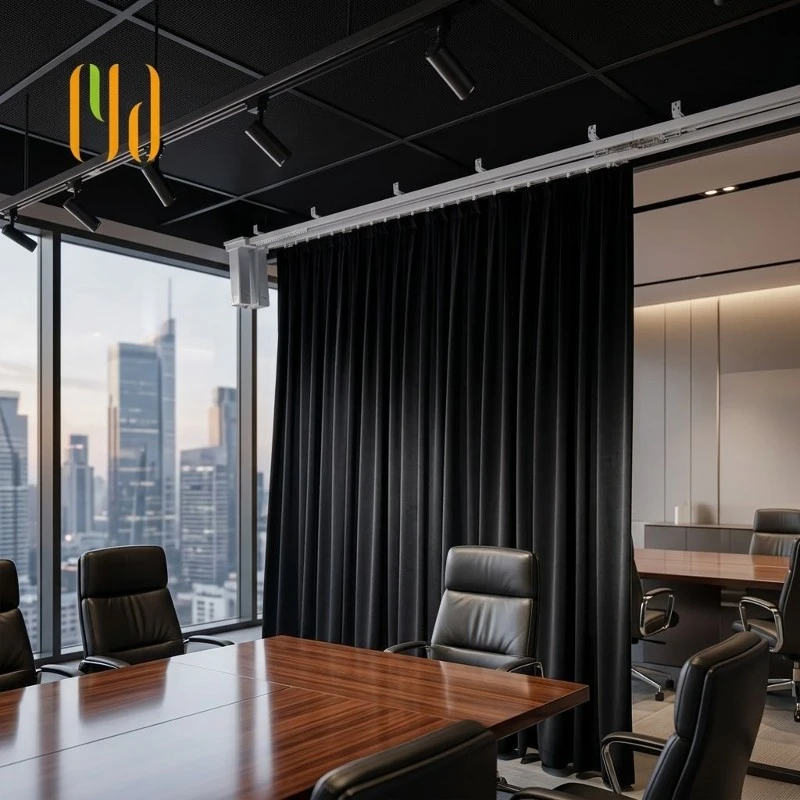
In a conference room the curtain is a working surface as much as a decoration. Hung flat across the end wall it removes the glare and the distraction behind the screen, sharpens the contrast of a projected image, and gives the room a calm, even backdrop for video calls. Full-height panels also hide the wall's services and any uneven finishes.
Banquet hall
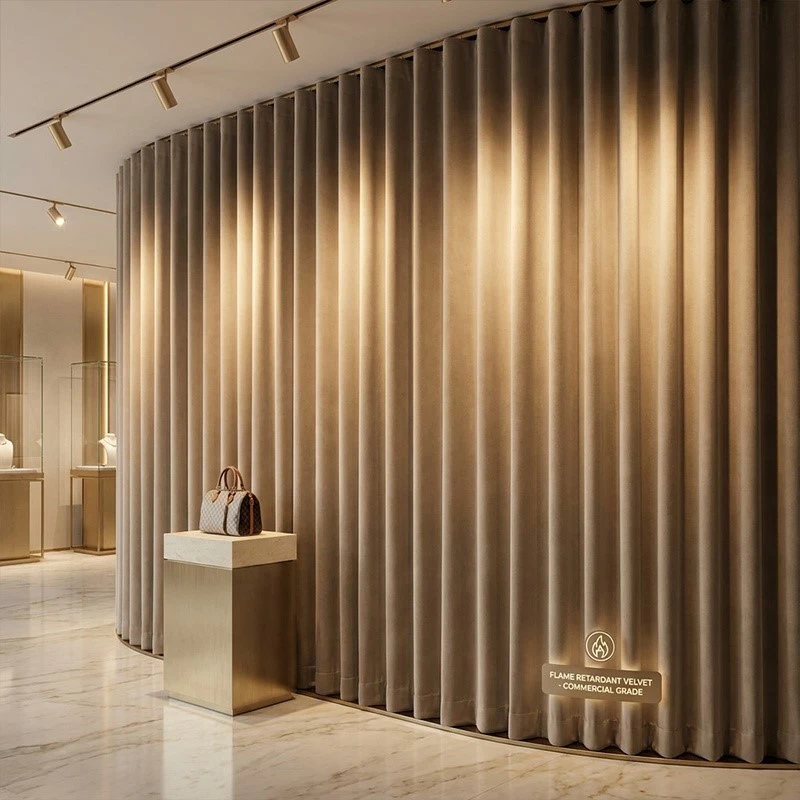
In a banquet hall the curtain carries the room's mood. A pleated velvet wall behind the top table gives the event a focal point, softens the hard shell of a large room, and adds the acoustic absorption that stops a full room from sounding shrill. Because guests photograph the table, the drape is usually the most decorative element in the space.

Auditorium and lecture hall
In a lecture hall the curtain does two jobs at once. It closes the sightlines so a late arrival cannot see into the wings, and it treats the sound in a room built from hard surfaces, reducing the echo that makes speech hard to follow. It also gives the stage a neutral field behind a speaker, so attention stays on the person rather than the wall.

Available fabric varieties
|
Fabric No. |
Width(cm) |
Weight |
Composition |
Feature |
Description |
MOQ/m |
|
CHV029 |
155 |
320 |
100%IFR polyester |
IFR |
Warp Knitting Velvet |
500 |
|
CHV029-W |
310 |
280 |
100%IFR polyester |
IFR |
Warp Knitting Velvet |
1000 |
|
CHV027(22oz) |
155 |
420 |
100%IFR polyester |
IFR |
Warp Knitting Velvet |
500 |
|
CHV027-W |
310 |
420 |
100%IFR polyester |
IFR |
Warp Knitting Velvet |
1000 |
|
CHV027(250z) |
153 |
480 |
100%IFR polyester |
IFR |
Warp Knitting Velour |
500 |
|
CHV020 |
155 |
500 |
100%IFR polyester |
IFR |
Warp Knitting Velour |
5000 |
|
CHV021 |
150 |
320 |
100%IFR polyester |
IFR |
Molton Woven Brushed |
3000 |
|
CHV021-W |
300 |
320 |
100%IFR polyester |
IFR |
Molton Woven Brushed |
3000 |
|
CHG023 |
140 |
500 |
100%IFR polyester |
IFR |
Woven Cut Velvet |
300 |
|
CHG024 |
140 |
570 |
100%IFR polyester |
IFR |
Woven Cut Velvet |
300 |
|
CHW025 |
150 |
320 |
80%Wool,20% |
FR |
Molton Double side brushed |
1000 |
|
CHW026 |
150 |
480 |
80%Wool,20% |
FR |
Molton Double side brushed |
1000 |
|
CHD016 |
300 |
250 |
100%IFR polyester |
IFR |
Woven TwillBlackout |
500 |
|
CHD021 |
300 |
210 |
100%IFR polyester |
IFR |
Stain |
3000 |
|
CHS040 |
300 |
50 |
100%IFR polyester |
IFR |
Terylene Voile |
1000 |
|
CHS041 |
200 |
55 |
100%IFR polyester |
IFR |
Pongee |
5000 |
Available Colours
Two performance
Flame Retardancy
The flame performance of a theatrical curtain starts with the fabric itself. The curtains are woven from heavy, densely constructed velvet-type yarns, and flame-retardancy performance is applied through the yarn spinning processing so the protection sits within the cloth rather than on its surface. This makes the fabric has inherently flame retardant effect and the effect will not reduce after washed.
Flame-retardant performance test
Our flame retardant Theatrical fabric can pass the following Standards:
|
|
CN:GB20286-2006 |
 |
DE:DIN4102-B1,DIN54342 |
|
|
USA:NFPA701,CA117,CFR1615 |
 |
JP: JIS-L-1091 |
|
|
ER:NFP92-507-M1 |
 |
ESP:EN13773:2003 |
|
|
UK:BS5852,BS5438,BS5867,BS476-CLASS |


Acoustic Performance
A theater curtain behaves as a large absorber. Heavy, densely woven fabric is porous at the surface, so sound energy enters the cloth instead of reflecting straight back into the hall, while the deep, regular pleats hold air between the fabric and the wall. That combination - porous material plus a trapped cavity - is what reduces reflected sound rather than only blocking it.
How much absorption a curtain contributes depends on how it is made up and hung: pleat density, the amount of fabric gathered into the track, the depth of the folds, and the distance between the fabric and the wall all influence the result, as does the proportion of the room's surfaces the curtains cover. In practice these variables are used to shape reverberation time and improve speech intelligibility in halls that would otherwise sound harsh.
Because the drape set is made to order, fabric and pleat ratio can be adjusted to the requirement of the project's acoustic consultant, and coordinated acoustic testing can be arranged so the specified configuration is verified rather than assumed.
Acoustic test report


Our Factory
SUZHOU CHENGYUDA TEXTILE CO.,LTD, specialized in flame retardant curtain fabric especially fire-resistant fabrics and fireproof for 15+ years, We have developed a variety of different flame-retardant theater curtain fabrics suitable for various scenarios including 15/22/25 oz velour velvet fabric, Matte dimout fabric, Molton CS fabric, Medium Gloss Satin Fabric and etc., Each of them has there own characteristics to meet the fire safety requirements of different countries.
We have established partnerships with many countries around the world like USA, Australia, Canada, Spain, Netherlands, Russia, Singapore, etc
We sincerely endeavor and look forward to working with our partners both in supply and sale ends to create a brighter future!


FAQ
Q: 1.Are the stage drape fabrics flame retardant, and can you supply test documentation?
A: Yes. The stage drape range is flame retardant, and testing can be arranged against the framework required by the project's location and venue authority. Reports can be issued together with the shipment so the venue holds a complete compliance record.
Q: 2.How do you support the acoustic requirement?
A: Drape fabric and pleat ratio can be adjusted to the requirement of the project's acoustic consultant, and coordinated acoustic testing can be arranged so the specified configuration is verified rather than assumed.
Q: 3.Can sizes and pleat ratio be customized?
A: Yes. Every drape is made to measure: stage opening, hanging height and pleat ratio are confirmed from drawings or site measurement before production.
Q: 4.What colors and fabrics are available?
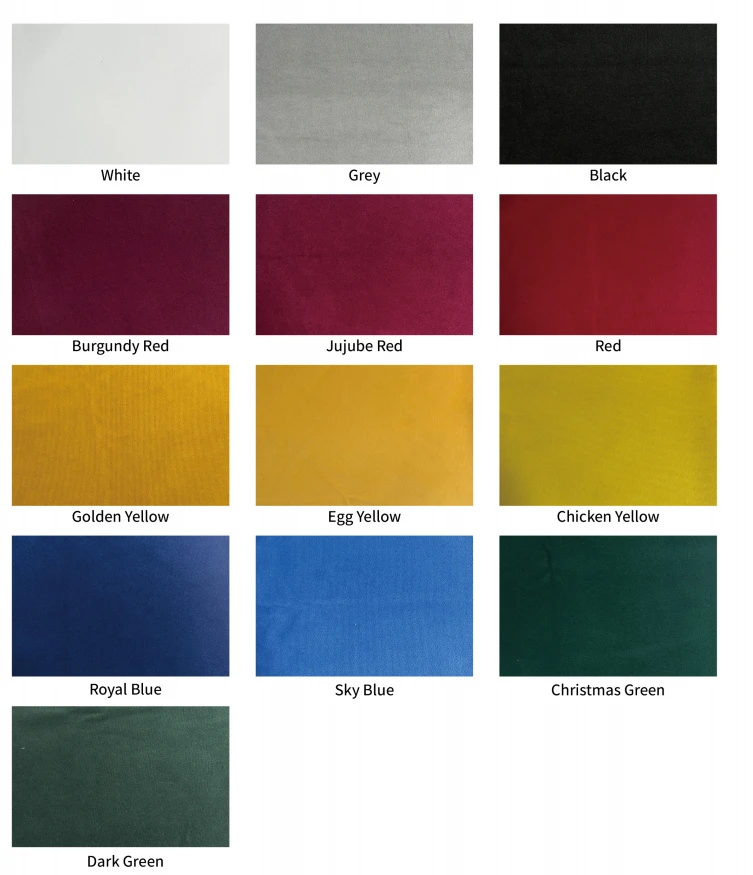
A: A coordinated range including velvet-type and dense matte weaves in burgundy, navy, gold, white, black and further shades, with custom colors matched to the auditorium interior on request.
Q: 5.What track and control options do you offer?
A: Motorized and manual track systems, matched to drape weight, stage layout and the venue's rigging and safety requirements.
Q: 6.How should the stage drapes be cleaned and maintained?
A: Follow the recommended washing and drying method, avoid incompatible cleaning agents, and have the fabric rechecked for flame performance after repeated laundering or major repairs.
Q: 7.Do you provide installation guidance, and can the set be fitted to an existing stage or renovation?
A: Yes. Hanging method, distance from the wall and safe clearance from heat sources are agreed at specification stage. Existing tracks, openings and rigging can be surveyed and the drape set specified to suit, whether the project is a new build or a refurbishment.
Q: 8.Can parts of the set be operated separately?
A: Yes. The main drape, act curtain and masking can be hung on separate tracks or operating lines so each can be run independently, and the split is set to the stage layout and the way the production runs.
Q: 9.Do you offer samples?
A: Yes. Fabric swatches are available and the cost is customized on request; sample fees are typically deducted from the first order.
Q: 10.What is the MOQ, lead time and packing?
A: MOQ and lead time are customized on request depending on drape type, fabric and quantity; drapes are folded and packed in export cartons with protection for the hems and folds.
Q: 11.Can you provide OEM/ODM branding?
A: Yes. Custom labels, packaging and branding are available - send your artwork and we will confirm the details.
Hot Tags: ifr velour, China ifr velour manufacturers, suppliers, factory, 15 oz Cotton velour fabric, 20 Oz velvet Fabric, 23 Oz Cotton Velour Fabric, Molton CS stage curtian fabric, pipe and drape


