The development of curtains has undergone many changes, the most obvious of which is reflected in the material of curtains. At the beginning, windows were simply chiseled or left with very rough holes in walls and ceilings or openings in the style of Indian conical tents skylights. Their basic purpose was limited to ventilation, and these holes and openings were often covered with woven fabrics made of animal skins or grass. Animal skin and grass mats were the earliest forms of curtains, and due to the beauty of grass mats, this type of window decoration is often hung by families in the southern summer to cool off.
After Cai Lun invented paper in the Han Dynasty, people began using it as a cover for windows. In ancient China, windows were covered with window paper, and the window openings were very small and dense. One reason was to prevent theft, and the other was that the window openings were too large and the window paper was easily torn by the wind.
This kind of paper pasted grid window is very common in northern residential buildings. The paper used to paste windows is called sorghum paper, which is white, has a certain thickness and toughness, and is not easily broken unless intentionally damaged.
After the emergence of fabric art in the Song Dynasty, people used it as window decoration because of its rich patterns and lightweight design, which embodied the charm of curtains. Fabric curtains can be divided into cotton gauze, polyester fabric, polyester cotton blend, cotton linen blend, etc. Different materials, textures, colors, patterns, etc. are combined to form different styles of fabric curtains, which complement different styles of interior design. That's also why people still like to use cloth as curtains.
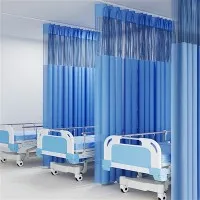
In modern times, due to the development of technology, the material of curtain fabric has made a leap forward, and curtains made of aluminum alloy, wood chips, and non-woven fabrics have emerged. These curtains are collectively referred to as simple curtains. With the advancement of technology and the development of flame retardant technology, various functional curtains continue to emerge, which can be summarized as flame retardant, energy-saving, sound-absorbing, soundproof, antibacterial, mildew proof, waterproof, oil proof, anti fouling, dustproof, anti-static, alarm, lighting, high-temperature steam shaping and other curtains, as well as multifunctional curtains that integrate the above functions.
In modern times, due to the shift in consumer aesthetics and the gradual strengthening of environmental awareness, curtains not only reflect the expression of a room, but also reflect the owner's taste and temperament in life. A graceful, simple and elegant curtain can add icing on the cake to a living room. In addition to decorative functions, the material, function, and comfort of curtains are also closely related to our health and life. Therefore, insulation curtains, UV resistant curtains, high-temperature fixed curtains, and modern minimalist style curtains are becoming increasingly popular among consumers and white-collar workers.
Curtains coexist with our space, with a myriad of styles and styles, and their functional uses are refined to any place where they can be used. European, Korean, Chinese, Japanese, high-temperature fixed curtains, thermal insulation curtains, UV resistant curtains, one-way perspective curtains, roller blinds, sunshades, soundproof curtains, ceiling curtains, sky curtains, blinds, Roman curtains, wooden curtains, bamboo curtains, metal curtains, organ curtains, water wave curtains, vertical movable curtains, electric curtains, manual curtains.
The Development Of Curtains
Sep 03, 2024
Leave a message
You Might Also Like